At some point, any company starts to face the question of how to manage its digital marketing strategy. Whereas large corporations have reason to weigh the options between hiring an agency vs. creating an inside team, small and medium companies are better off 99.9% of the time when they choose an outside agency. Here is why.
Synergy of knowledge
The main benefit of using an external PPC agency for managing your paid advertising campaigns is that you hire not simply a specialist (your account manager), but a whole team of experts who can contribute their own special skills, for example: campaign optimization, planning and creating an effective PPC plan, designing optimal landing page, etc.
Extra external knowledge
PPC agencies not only obtain official certifications of expertise from the advertising platforms, they also usually have good relationship with representatives of PPC platforms. This can benefit a company in various ways as the PPC agency has access to tailored tips for improvement directly from a representative of Google or Bing that are generally not available otherwise.

Ready to go experts
When a company decides to train an employee internally or to hire a more experienced staff, time is required to bring the “newbie” up to speed and to work through the inevitable beginner’s mistakes.
A PPC agency, on the other hand, will many times already be well acquainted with your business niche owing to work with similar companies and may bring to the table fresh ideas based on this experience. And even if this is not the case, the community of PPC marketers is very friendly, so an expert from your chosen PPC agency can tap into colleagues’ knowledge.
Strategy in the first place
A good PPC agency will share your vision and will help to adjust your PPC goals to the company’s long-term business goals. An internal employee or team will not necessarily have the needed strategic thinking for optimizing your campaigns – an improvement of PPC KPI may be flattering for a recent PPC specialist, but a PPC expert would be looking deeper into the global picture.
Pricing
PPC agency pricing is generally based on either a fixed hourly rate or a set percentage of an advertising budget. A relatively new approach allows an advertising agency to receive shares in the company, which makes for a very powerful incentive.
Hiring a PPC agency will save you money spent on HR services for finding a new candidate and the usual salary and taxes, but as well on all the training of the new specialist.
Conclusion
Every company, including yours, deserves a personalized approach that reflects your long-term goals, and an external PPC agency is the answer that most SMB companies need, one that saves time and money and provides quality results.
If you are “do it yourself” kind of company, here are useful tips How To Get a 10 Point Quality Score In AdWords Campaings or you can learn more about the services we offer.
Next to the usage of a pure broad match for one-word keywords, botched geotargeting is the second biggest waste of your money in an AdWords campaign.
If you are detail-oriented (and if you’re doing PPC advertising you definitely should be), a careful setup of campaign’s location targeting will not only optimize your budget but will also give you insights that you only dreamed of before.
Which location settings to use in your campaign
The choice of settings depends on the answer to what seems to be a fairly simple question:
Where are the people who are searching for what I offer?
The answer depends on the type of a campaign.
General rule
Let’s imagine you want to advertise a local business in a city. It’s logical that the targeted area in a search campaign would be that city, but actually, the targeting depends a lot on your business type.
For example, a consulting company or first-class hairdresser can easily attract people to come from another city or even a nearby state, which means that these areas should be targeted as well. For other companies, however, the option “People in, searching for, or who show interest in my targeted location (recommended)” would cover all the interest.
Some companies can benefit greatly from radius targeting. Let’s take a veterinarian on call service as an example. Targeting the main city is great, but is not enough because many searches will be missed; on the other hand, targeting the state would be too broad. In such cases, radius geo-targeting identifies only those potential clients within an hour’s drive away.
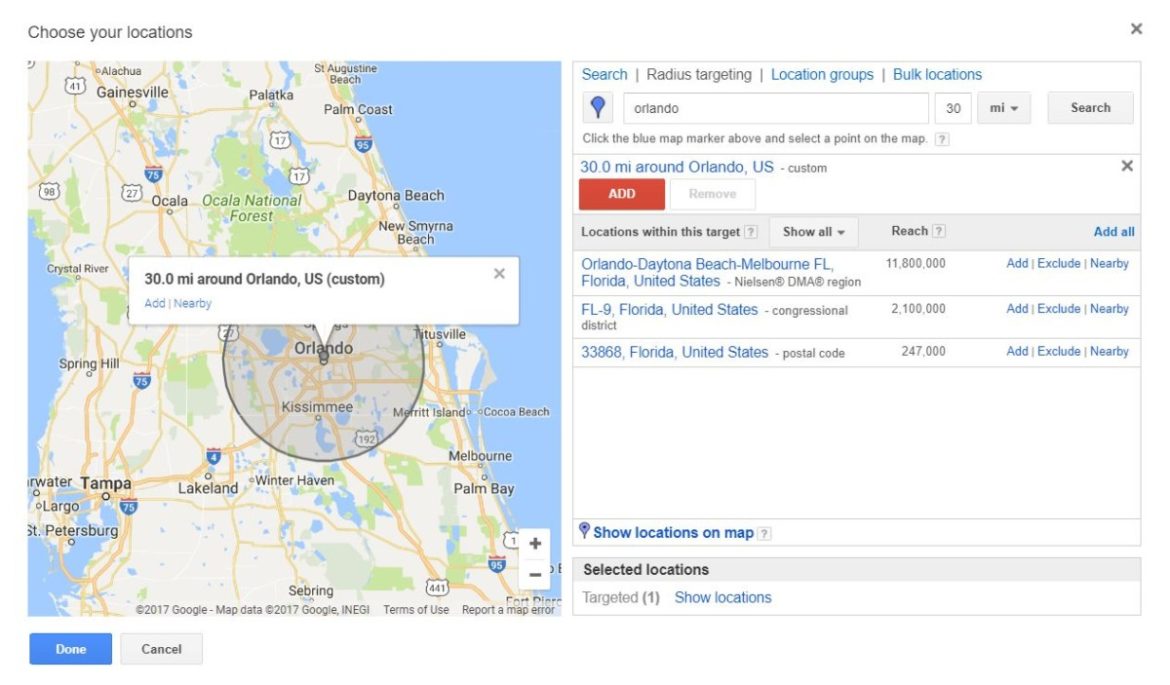
Since radius targeting can focus down to distances as small as one mile, it can be very specific – for example focusing on pizza delivery in just one part of a city.
Special cases
When it comes to more advanced campaigns, however, geo-targeting may need to be approached from another angle.
Suppose you are targeting searches by people from State A; then for remarketing, you might as well include states around State A, since some of the searches will have been done by people in other states who will be coming to State A on business trips. If your type of business has the potential to attract clientele from a larger area (for example, if you can deliver your product to any state in the country), then including these extra regions can only benefit you.
There’s also an amazing option for some companies to target directly a specific type of location, such as airports or universities. A local taxi company, for instance, can benefit from this option by setting up two campaigns, one focused on the city and another on the airport.
How to obtain more data from detailed geo-targeting
Adwords location targeting can take a variety of forms. One is adjusting bids for a specific location. In practice, this means that you could target France in general with one bid and Paris with twice as high a bid, or have a different bid for every state while targeting the US.

However, this option provides less data in the end that it could.
The answer? If you have enough traffic, create separate campaigns targeting each location.
What this approach offers:
1. Control over the budget
-
If your budget is limited and allocation of resources is problematic, you can prioritize locations by focusing on the geographical area that is most important to you.
2. Getting a look at the competition
-
The competitor report that is available on the keyword level does not provide geographical segmentation, so it is difficult to determine what the competition is like in each state if, for example, you are targeting more than one.
3. Choosing the best bidding strategy
-
Bidding strategies are available also at the level of the individual campaign; by having multiple campaigns, you have the possibility for manual bidding in a specific location where you think a more detailed control is called for, and for a target CPA strategy in another location that might be a lesser priority at the moment and where your aim is just to keep within the stated CPA limit.
4. Control Quality Score by improving the chain Keyword-Ad-Landing page
-
When you have everything in one campaign, you’ll most likely end up with general keywords and keywords with a name of a location in combination with the general ad text and general landing page content. The best possible way to improve your Quality Score, in this case, is keyword insertion in text ads. Having separate campaigns, you can test properly the ad text related to the local keywords and can adjust landing page content efficiently.
The precision afforded by dividing campaigns according to location will give you more control, which will lead in turn to better reporting options and better results. Isn’t this the whole point?
Before getting into the specifics of a converged media content strategy, it’s important to first get a better understanding of the meaning of paid, earned and owned media. If you’ve been privy to the digital world you may have heard these buzzwords passed around, but what is the difference between them and what does it mean for your digital strategy?
Know the difference
Paid media
is often considered to be “traditional advertising” and includes banner ads, paid search marketing, sponsorship and content syndication. Paid media initiatives usually target prospects in an effort to create brand awareness or new customer acquisition. The great thing about paid media is that it scales really fast. If you have a message that you want to be seen by the mass market, paid media is the right channel to do that. While it can certainly be expensive, you have complete control over the creative, content and marketing spend.
The disadvantages with using paid media alone are that consumers often ignore pure “brand messages” since they are already inundated daily with advertising messages and not just from your competitors either. Every other large brand with a marketing message and a significant budget is fighting for their attention.
Owned media
is any web property that you can control and is unique to your brand. One of the most common examples is a website, although blog sites and social media channels are other examples of owned media properties too. Channels like social media and blogs are extensions of your website, and all three are extensions of your brand as a whole. The more owned media you have, the more chances you have to extend your brand presence in the digital sphere.
Many believe that owned media is free, specifically managing social media accounts. While there is a sliver of truth to that, the time and labor investment are not free… it takes a lot of time to create content, build a thriving community and value to the customer conversation. You also have to consider working with customer support teams, building escalation models, and preparing for crisis communications as well. This takes a lot of time planning and collaborating with other team members and time is money.
Earned media
can be explained as the vehicle that helps people get to the destination (owned media sites). What good is a website or social media site if no one is seeing or interacting with it? That’s where earned media comes in. Earned media is essentially the online word of mouth, usually seen in the form of ‘viral’ tendencies, mentions, shares, reposts, reviews, recommendations, or content picked up by third-party sites.
One of the most effective driving forces of earned media is usually a combined result of strong organic rankings on the Search Engines, and content distributed by the brand. First page rankings and good content are typically the biggest drivers. Rankings on the first page of the search engines place your owned media sites and content links in a position to receive higher engagement and shares, which is why a good SEO strategy is crucial.
When it comes to brand content, interesting, informative content can come in all shapes and sizes. Whether it be a blog, infographic, video, press release, webinar or e-book, the bottom line is that the content has to be worthwhile in order to receive the valuable earned media; which is why a great content strategy is also important.
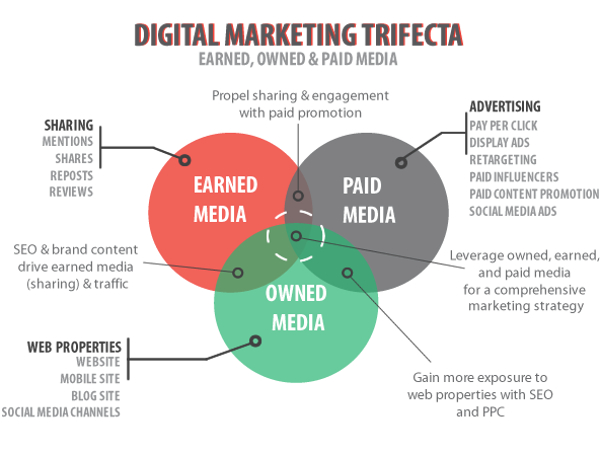
Think of earned, owned and paid media like a tripod. Each element is an important part of the whole and all contribute to a complete digital marketing strategy. Ultimately these types of media work best together but making the hard choices of what to include and what not to include is crucial – especially when budgets are tight. But if you simply start by categorizing your media and identifying the right roles based on your objectives, then you’re on the right path.
How to Integrate the Channels
While each of these channels will play a critical role in your content strategy, the real power is when you can integrate two or more of the channels into one campaign or initiative. This is referred to as converged media. The same thinking has led to the recent surge in “native advertising”. Sites such as Buzzfeed, Crave and Forbes are capitalizing on the opportunity to mobilize their lean but hungry editorial teams to create paid content for brands that live alongside the site’s original content.
Examples: Content Coverage
This is perhaps the most powerful of the content promotion channels. Earning attention for a brand’s content can drive brand awareness, traffic, and conversions. Here are a few ways you can get more content coverage.
a) Media Relations
This is a tried-and-true stalwart of public relations (PR), but it doesn’t have to be all about pitching the brand, product, and service stories to journalists and editors. Marketers and PR professionals alike can pitch a brand’s e-book, guide, study, etc. if it’s prudent to the audience of the publication.
b) Influencer Outreach
Also known as influencer marketing or influencer advocacy, influencer outreach is quite similar to media relations though typically, the people targeted are influential in their industry and aren’t necessarily journalists or editors. Influencers can be bloggers or people that amass large social followings around their industry expertise. The result of outreach can lead to something as simple as a social share, a direct or indirect endorsement on a blog, or full-on collaboration with a project or campaign.
c) Bylined Articles
These result when media outlets invite company executives with a very specific expertise to write for them. Some are one-and-done, and others are a series of articles or even a weekly column. Bylines cost nothing, but it takes time to research the media and pitch why a brand’s executive should write for them. Once a byline is earned, citing e-books, guides, studies, and blog posts can drive large amounts of traffic and conversions.
d) Advertorials (Sponsored Content)
This is another way for brands to tap into another website’s audience. Brands using this tactic pay to publish articles on other websites or media outlets. The pieces usually look and feel much like the unsponsored content on the media site, but is denoted with a “sponsored” tag or sticker. Popularized by Forbes, online advertorials are beginning to crop up all over the Internet. However, media buying for sponsored content is still in its infancy. Pricing varies widely across the media — from a couple hundred dollars to six figures.
Brand new topic for you next week. See you then!
Every time someone does a search that triggers an ad that competes in an auction, Google calculates an Ad Rank that determines the position of the ad. Google estimates the quality of your ads and the landing pages triggered by your keyword, evaluating your keywords on a scale from 1 to 10, where 10 is the best. The components of the quality score are determined every time your keyword matches a customer’s search.
Why is quality score so important?
The quality components of Ad Rank are used in several different ways and can affect the following aspects of your account:
Ad auction eligibility: Having better QS makes it easier and cheaper for your ads to enter an auction. It helps to determine whether your ad is qualified to appear at all.
Your CPC: You pay less per click when your ads are higher quality.
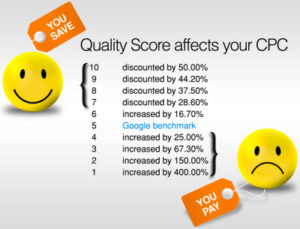
Your keyword’s first page bid estimate and top of page bid estimate: Higher quality ads are typically associated with lower first page bid estimates. That means it’s easier for your ads to appear on the first page/top of page of search results.
Ad position: Higher quality ads lead to higher ad positions.
Eligibility for ad extensions: Some ad formats require a minimum threshold of ad quality in order to show. In addition, your Ad Rank determines whether or not your ad is eligible to be displayed with ad extensions, such as sitelinks.

Threefold of 10 point quality score
At its core, optimization of quality score means optimization of CTR. To achieve this optimization, you will need to work on all the factors on which it depends. Those are:
Expected CTR: How well your keyword has performed in the past, based on your ad’s position.
Ad relevance: How closely related the KW is to the ad.
Landing page experience: The extent to which your landing page is related to the search term, how it is organized and how easy it is to navigate.
Steps for improving quality score
As you can see from the previous paragraph – it matters how specific you are about the structure of keywords in the campaign. The following steps can lead to immediate improvement in your quality score:
1. Create separate groups
In your account, you should be creating multiple ad groups for your keywords based on the amount of traffic.
At first sight, some keywords seem to make sense together; thus, for example, “creation of website” and “creation of homepage” both refer to creating a web page, but the latter refers more specifically to the best practices regarding information to be put on the homepage.
If the more generic keywords receive a lot of traffic, use the search term report to check the words people are typing when they see your ad. You might notice misspellings or other trends (such as adding a street name to the query) that have KPIs that differ from the main keyword – this is one of the main signs that you might want to consider placing them in separate ad groups.
2. Use keywords in ad text
This action benefits you in two ways:
-
a) Google search results highlight keywords matching the text in the ad, so your ad becomes more visible for viewers, bolstering the positive changes created by increasing CTR.
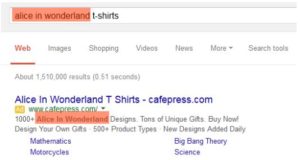
b) This approach makes ads seem more relevant to the keyword you’re bidding for. From my personal experience, using a keyword in an ad twice instead of once increases the quality score from 7 to 10, and does so without significant CTR changes (the CPC still drops quite noticeably).
Fix landing page (LP) experience
Bad landing page can kill all the effort put into keyword-ad relevance. To prevent this, first make sure that the landing page you’re using is relevant to the keyword in terms of content; it mainly includes using keywords in the texts on the web page. Second, think about the general landing page experience for a newcomer to the website– does he or she get the expected result from your website after clicking the ad?
Significant factors here include:
- Website loading speed
- Navigation
- Conversion rate
If the campaign’s keywords are quite diverse you might consider creating more landing pages to fit the demand and to avoid reducing the general quality score of the account.
Conclusion
A high quality score not only improves PPC metrics like CTR and drives more traffic, but also actually saves you money. The time spent making your campaign structure relevant on the path “keyword -> ad -> landing page” will result in lower CPC and better quality of users.
In the battle for marketing attention SEO and PPC are in constant competition with one another. As Google changes its algorithms, companies find themselves competing against moving goal posts. SEO can be a slow process, and businesses in competitive industries may never be able to hold onto the number one ranking they desire. That’s why more money is funneled into PPC advertising.
If your company is committed to PPC or social media advertising, there are two ways to get it done. You can entrust the campaigns to someone in-house, or you can hire a PPC management company. In an increasingly competitive and rapidly evolving PPC landscape, managing PPC campaigns in house becomes more and more difficult and time-consuming. Hiring a pay per click management company allows companies to focus on their core business objectives and leave online marketing to experts whose sole purpose is to bring positive ROI from their PPC campaigns.
However, even marketing veterans can make mistakes when they enter into a new market, or start selling a new product with PPC. It takes an expert PPC analyst to review every potential facet of your account, looking for ways to improve on the copy and the landing page.
If you’re new to PPC, you may be unaware that it will cost you less to hire an expert than it will to launch a campaign on your own.
Here are 8 reasons why you should hire a PPC management expert:
1. The Ability to Focus Exclusively on PPC Management
An in-house PPC manager has a multitude of responsibilities that are not associated with PPC. This differs in every company, but often in-house PPC managers wear many hats. Not only does a marketing manager run the company’s PPC account, they also hosts webinars, deal with payroll, and reports to management about employee productivity, among many other things. All of this takes the focus away from PPC. PPC needs constant attention if it is to be done correctly. PPC management companies have no responsibilities other than optimizing their accounts and employing the tricks of the trade.
2. Wrong Ad Copy Could Result in Low Conversion
One of the greatest strengths a PPC expert has is the ability to perform competitive research. PPC experts understand how to find good copy, they study your competition, and they form ads based on what they know works. That kind of copy isn’t something the amateur can do overnight, especially when every word means something.
The right copy can elevate your campaign’s click-through rate and net you more conversions. Do you really want to take a chance on writing the wrong copy? Bad copy that does not convey the right message, and is only trying to get you more traffic, may result in low conversion, meaning you just wasted lots of money.
3. Mastering the Keyword Research
Keyword research is crucial to your success, and it’s something PPC experts spend a lot of time on initially and throughout the PPC process. If you pick the wrong keywords you can quickly exhaust your budget and your campaign will have very poor returns.
There are free keyword tools, such as Google’s Keyword Tool, that anyone can use, but the better tools are usually the paid ones. Paid tools would give you a competitive advantage, but at a price. Some of these tools can cost upward of $100 monthly in addition to your other expenses. PPC experts don’t stop at one of these tools, either. They use multiple data points to form a more complete picture of the sales landscape.
4. Campaign Settings Can Be Confusing
There are several potential settings you must adjust in order to get optimum exposure for your campaigns. For example, geographic settings can help you target a specific part of the country. Should you target locally, statewide, nationally, or worldwide? Should you set up different ad groups for each? Should you opt-in to partner/affiliate networks and if so should you bid the same as the search network? If you choose the partner networks, should you filter out some specific sites? Without a clear understanding of these settings, and how they may benefit you, you might be paying too much for the same traffic that a similar marketer pays pennies on the dollar for. Without expert advice or some experience, you would never know.
5. Bid/Campaign Management Tools
Successful PPC marketing requires skilled and creative human marketers, but without great technology to aid them, PPC marketers are limited. Most PPC management agencies have PPC bid management tools to update client bids to target position 365 days a year, which means peace of mind for you. These tools are expensive and have a learning curve even for experienced PPC Marketers. The best PPC management companies tend to have the best technology in addition to experienced marketers. Technology for PPC campaign management aids with automation of bid management, rapid deployment of changes and new campaigns, and real-time analysis and updates.
6. The World of PPC is Always Changing
Where in-house PPC managers have a host of other responsibilities, PPC management companies can concentrate on the art of PPC. A large part of this is recognizing and working with global search trends and constantly keeping oneself updated. Agencies have time to dedicate to learning the nuances of the industry. Since there are always changes in AdWords and AdCenter, there must be time dedicated to learning about these changes and how they can affect an account.
7. Tracking Requires Technical Expertise
The foundation of any good PPC program is its ability to track not only sales, but where those sales are coming from. Good analysis can show you which placements and keywords are likely to bring you the most conversions.
In addition, tagging your campaigns allows you to see which ones are most effective. Tracking code installation requires at least some basic HTML knowledge, so if you have no such knowledge then you better leave this to the experts or you may have to pay your webmaster to install it for you. If you would like to track your leads/sales from phone calls, that would require additional set up and expertise.
8. Office Politics
There are no office politics to worry about at PPC agencies. We have our work to do and a budget to adhere to and it’s that simple. In-house managers often have to fight for resources. When it comes to manpower, it’s nice to know here at an agency that all these little things are a non-issue. Additionally, it is more difficult to convince a superior that more money needs to be put into PPC efforts than convincing a client. It’s the agency PPC manager job to tell the client how or where to spend money and if it is worth spending more whereas office politics can make it hard to ask a superior for more money for a “department.” In this sour economic time, we are sure all departments would like more money to operate. All of this discomfort can be avoided when working with an agency.
Conclusion
Unless you have some prior PPC experience yourself, then we do not recommend you to waste money on a tricky trial and error method and to not waste time with constant changes of the PPC world. Hire a PPC expert or an agency to handle things for you instead. If you choose your PPC agency well, it is cheaper yet more effective.
The People aspect of business is really what it is all about. Rule #1: Think of customers as individuals.
Once we think that way, we realize our business is our customer, not our product or services. Putting all the focus on the merchandise in our store, or the services our corporation offers, leaves out the most important component: each individual customer.
Keeping them in mind, here are some easy, down-home customer service tips to keep them coming back!
1. Unhappy employee, unhappy customer
Remember there is no way the quality of customer service can exceed the quality of the people who provide it. Think you can get by paying the lowest wage, giving the fewest of benefits, doing the least training for your employees? It will show. Companies don’t help customers, people do.
2. For good customer service, go the extra mile
Include a thank-you note in a customer’s package; send a birthday card; clip the article when you see their name or photo in print; write a congratulatory note when they get a promotion. There are all sorts of ways for you to keep in touch with your customers and to bring them closer to you. For example instead of asking customers to buy directly at holiday time, Miki Segal, chief marketing officer at JMAC Supply, sends customers a small token of gratitude with a card to make a personal connection. She believes that instead of making a product pitch, she shows how much she values the relationship.
For your business: Forget expensive gifts. What can you send thoughtfully to a customer to show that you value their business? Video greeting cards are easy to make and share online with tools like GoAnimate and Animoto. Customers are also impressed with donations to their favorite charities.
3. Realize that your people will treat your customer the way they are treated
Employees take their cue from management. Do you greet your employees enthusiastically each day; are you polite in your dealings with them; do you try to accommodate their requests; do you listen to them when they speak? Consistent rude customer service is a reflection not as much of the employee as of the management.
Try providing a direct line of communication between owner and customer. Oren Dobronsky, president of Oren’s Hummus Shop, a restaurant in Palo Alto, California, fears bad feedback from his customers. He knows there’s a higher risk for it on busier days, such as holidays and special events. Dobronsky found that when he’s at his restaurant, employees perform better and there are fewer complaints. Unfortunately, he can’t always be there.
To solve the problem, Dobronsky created Owner Listens, which is an app business owners can sign up for that enables customers to text or email with the owner personally (and anonymously if desired). He says customers are “blown away” when they get a quick direct response from him. Dobronsky promotes this service on his restaurant tables and bill folders. Now, his staff works harder to ensure that no bad feedback goes directly to the owner. He says it’s like always having a secret holiday shopper in the room.
For your business: How can you offer the opportunity for the customer to give direct feedback to you?
4. Use video
One of the best customer experience features on the new Kindle Fire tablet is a “Mayday” button that gets a human tech support representative on the screen in a pop up window. It’s actually a live video feed of an Amazon customer support person who is there to help. (Don’t worry, they can’t see the user.) When Warby Parker discovered how difficult it was to answer complicated questions in just 140 characters, they decided to leverage videos to help customers resolve their issues. Employees got on camera to nuke questions on prescriptions, frames, and even shipping times for glasses. Their customers were so blown away by the videos that they started spreading the word about them.
For your business: How can you offer pop up video chat on your website during peak hours in addition to email and phone support?
5. Check in With Customers
Following up with new customers can be a great help for navigating the onboarding process. But there are a lot more creative ways to follow up with customers than a simple auto-responder email. For example from Bark Park, a doggy daycare center, employees write an update card for customers that details how their dog has been doing that week … and the reports are written from the dog’s perspective!
This creative take on checking in with customers is absolutely perfect for this sort of business. I know a lot of people who care for their dogs like parents care for their children, so getting a card like that puts their minds at ease and makes the business stand out in a unique way.
6. Don’t Let Red Tape Get in the Way
Zappos is a company that is connected to some legendary stories of amazing service. One story about an employee who took service to the next level has some interesting lessons to teach businesses about the dangers of red tape.
A customer was shopping for shoes for her elderly mother. Due to her medical condition, her mother had very sensitive feet and was often in pain when wearing hard-soled shoes. The customer bought six pairs of shoes from Zappos, and her mother tried them on and found two that she could bear to wear for long periods of time.
When it was time for her mother to return the other four pairs, she called Zappos and began this amazing tale of kindness:
In talking with the employee, this elderly woman discovered that the person on the other end of the line could readily relate to her plight; the employee’s father had suffered from similar foot problems due to diabetes. The employee ended the conversation by saying that she would pray for the woman to feel better … but the story doesn’t end there.
The Zappos employee sent her a bouquet of lilies and roses to let her know she was thinking of her. After the woman’s daughters thanked Zappos for taking such good care of their mom, Zappos responded with placing all of them on ‘Zappos VIP Members’ list which entitled them to free expedited shipping on all their orders.
Zappos’ insistence on building a company of sincere and reactive employees (and not of policy-controlled robots that let red tape get in the way of doing the right thing!) is largely the reason they are so beloved by customers.
The icing on the cake? The customer closed out her praise for Zappos with this message: “My sister vows to buy every pair of shoes, from now on, from Zappos.”
Spring is a time of new beginnings, new possibilities. And that’s why we at Otavation decided to make an upgrade of our website to provide you with a clear presentation of who we are and how we can help your business flourish like cherry blossoms in spring.
As we stay up to date with latest online marketing trends and tools we felt it was time to update the look of our website too. We wanted to make it easier for you to find everything you need and so we changed the design, but …
… our services remain the same:
- Google Adwords,
- Bing Ads,
- Facebook Ads,
- LinkedIn Ads,
- Landing pages,
- … feel free to browse through our case studies and see an example of how we help our clients achieve their online marketing goals.
Meet the Team
Our team members work hard and share a common purpose: to help our clients beat their goals! Click through and learn a bit about the people you are working with at Otavation: about us
We are happy to keep offering our client a free consultation that helps them decide what online advertising strategy is the best fit for their business. Turn to our years of experience and book one now! Get a free consultation